Free vs Paid DMARC Monitoring: An Honest Decision Framework
Search for free vs paid DMARC monitoring and the results split cleanly in two: listicles of seven free tools, and MSP discussions arguing that roughly $10/domain/month is unjustifiable. Both sides are half right. Since Google and Yahoo began enforcing bulk-sender authentication on February 1, 2024, and Microsoft followed on May 5, 2025, some monitoring of what DMARC is and how aggregate reports work is close to universal — the only real question is which kind you need, and whether it should cost anything.
This article is the decision framework: a verdict table up front, verified free-tier caps, real paid prices (including ours), the contract fine print vendors don’t headline, and the cost math for the skeptics.
One disclosure before anything else: DMARCguard sells paid DMARC monitoring — and this article names the cases where you shouldn’t buy it, from us or anyone else.
Free or paid DMARC monitoring — the short answer
Here is the whole article in one table. Find your situation, take the verdict, and read the matching section below for the reasoning.
| Your situation | Verdict | Why |
|---|---|---|
| 1 personal or hobby domain, low volume | **Free** | Every free cap is comfortably above your needs |
| Single business domain, discovery phase (p=none), DNS on Cloudflare | **Free** | Cloudflare DMARC Management has no stated volume or domain caps |
| Already at p=reject, stable senders, just want a pulse | **Free** (digest-style) | A weekly summary catches new sources; nothing to triage daily |
| Business domain on a personal-use-only free tier | **Paid** | The blocker is the vendor's own terms, not features |
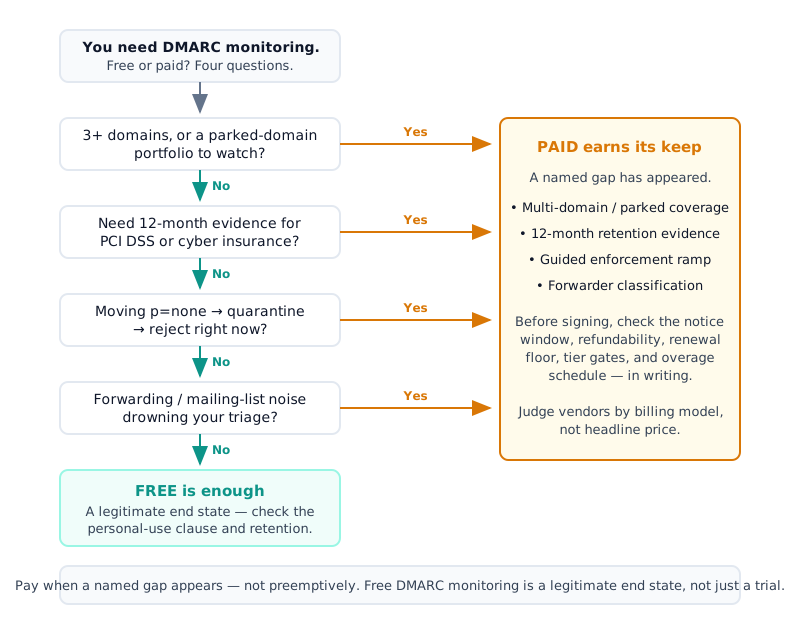
| 3+ domains or a parked-domain portfolio | **Paid** | Free tiers cap at 1–2 domains |
| Moving p=none → quarantine → reject | **Paid** (guided ramp) | Staged pct ramping and rollback need per-source readiness data |
| Forwarding/mailing-list noise drowning triage | **Paid** | Named sources and forwarder classification save the sorting |
| Need a long enforcement-evidence trail for a cyber-insurance renewal or audit | **Paid** | Free retention is 7–30 days; an evidence trail needs months of history |
The organizing principle behind every row: pay when a named gap appears — not preemptively. Free DMARC monitoring is a legitimate end state, not just a trial. If free is your answer, our full roster of free DMARC checkers, analyzers, and tiers covers every option in depth — this article deliberately doesn’t re-review them.
A note on method, because pricing articles rot: every cap, price, and contract clause below was checked against the vendor’s own pricing page or terms of service, access-dated 2026-07-28 and re-verified at publication. Where a vendor publishes no number, we say “not published” rather than guessing.
What do free DMARC tiers actually include?
The honest summary: most specialist free tiers are low-volume starter samples — typically 1 domain, 1,000–10,000 messages a month, and 7–30 days of retention. Here is what each vendor’s own page states (all accessed 2026-07-28):
| Vendor (free tier) | Domains | Volume/mo | Retention | Restriction |
|---|---|---|---|---|
| dmarcian Personal | 2 | 1,250 msgs | 1 month | Personal use only; business domains audited and expired |
| EasyDMARC Free | 1 | 1,000 emails | 14 days | Personal use only |
| PowerDMARC Free | 1 active | 10,000 emails | 10 days | Personal domains only |
| Valimail Monitor | No stated cap | No stated cap | — | 5 users, 10 SPF lookups, no automated DKIM |
| Cloudflare DMARC Management | No stated cap | No stated cap | Not stated | DNS must be on Cloudflare; apex domains only |
| DMARC Report Core | 1 | 10,000 msgs | 30 days | Aggregate (RUA) reports only |
| Postmark free digest | Unlimited | Truncated view | 7 days | Top 10 sources / 5 IPs each; weekly email only, no dashboard |
| Mailhardener Free | 1 | Fair use | 1 month | Personal or evaluation use only |
| DMARCguard Free (ours) | 2 | No volume meter | 30 days | None — no personal-use clause; 7 protocols (DMARC, SPF, DKIM, BIMI, MTA-STS, TLS-RPT, ARC) |
No free tier at all: Red Sift OnDMARC (14-day trial), Sendmarc (trial-style basic reporting), MXToolbox (paid-only DMARC), and URIports (one-month trial; its cheapest ongoing plan is USD 1.25/month for personal use). Sources: each vendor’s pricing page, accessed 2026-07-28.
Two observations worth sitting with. First, “free” almost always means “personal use only” among the DMARC specialists. dmarcian, EasyDMARC, PowerDMARC, and Mailhardener all restrict their free tiers this way — and dmarcian’s terms describe an acceptable-use audit that expires free accounts containing business domains. A business running on these tiers is often outside the vendor’s own terms, which makes “free” a compliance question, not a feature question. Second, the most generous free options are the platform plays, not the specialists: Cloudflare’s DMARC Management and Valimail Monitor publish no volume caps at all.
Free tiers also move under your feet. EasyDMARC cut its free plan to 1 domain and 1,000 emails/month around mid-2024 (the exact date isn’t published; the timing is a third-party characterization). Postmark raised DMARC Digests to $14/domain/month for new domains on April 15, 2024, per its own pricing notice. The UK NCSC removed DMARC aggregate reporting from Mail Check on March 24, 2025, and retired the service entirely on March 31, 2026. The counterweight: Cloudflare made DMARC Management generally available, free for every Cloudflare customer, on June 16, 2026.
17,000 UK organisations affected by the NCSC Mail Check retirement (2026-03-31), per dmarcian's estimate
How much does DMARC monitoring cost?
Paid pricing splits into two bands: cheap self-serve and quote-only enterprise. Entry self-serve prices, from each vendor’s own pricing page (accessed 2026-07-28; note where the headline number is an annual-billing rate):
| Vendor (entry paid) | Price | What it covers | Billing unit |
|---|---|---|---|
| URIports Pebble | USD 6/mo billed annually ($7 monthly) | 5 domains, 100,000 reports/mo, 30-day retention | Report quota |
| PowerDMARC Basic | From $8/mo billed yearly (volume-banded up to $250/mo) | 5 active domains, 1-year history | DMARC-compliant email volume |
| Postmark DMARC Digests | $14/domain/mo flat | All sources and IPs, 60-day history | Per domain |
| Mailhardener Standard | €19/mo (€199/year) | 1–10 domains, 3-month retention, hosted MTA-STS | Flat |
| dmarcian Basic | $19.99/mo billed yearly — $24/mo month-to-month | 2 domains, 100,000 msgs/mo, 3-month history | Domains + volume |
| DMARC Report Guard | $25/mo ($275/year) | 5 domains listed, unlimited beyond, 250,000 msgs/mo, 6-month history | Flat, unlimited domains |
| EasyDMARC Plus | $35.99/mo billed annually ($44.99 monthly) | 2 domains, from 100,000 emails/mo, 3-month history | Domains + volume |
| DMARCguard Pro (ours) | $29/mo including 2 domains, then $15/domain (3–10) and $10/domain (11+); annual = 2 months free | All 9 protocols, 1 year retention, all seats, PCI DSS and SOC 2 reporting included; add-on: Hosted DNS $12/domain/mo | Per domain, no volume meter |
Note the display convention on the dmarcian pricing page and most of its peers: the headline “$19.99/month” is the annual-billing rate; month-to-month is $24. EasyDMARC, PowerDMARC, and Red Sift use the same pattern. It isn’t dishonest, but it means you should mentally add ~20% to any headline price unless you’re prepaying a year. Our own numbers above are stated both ways for the same reason: the monthly card is $29/mo, and annual billing is $290/yr — 2 months free, with no headline trick to decode.
Above the self-serve band sits quote-only territory: Red Sift OnDMARC, Sendmarc, Mimecast, and Proofpoint publish no entry price on their own sites — that is “not published,” not “unknown but probably fine.” The one vendor-published enterprise floor is Valimail Enforce at “starting at $5,000/year” on Valimail’s own pricing page (secondary sources cite figures from $2,000 to $60,000/year; treat those as unverified).
If your question is narrower — which platform reads and presents the reports best rather than what it costs — our breakdown of the best DMARC reporting tools covers that side of the decision.
Put together, the market has three bands: free to ~$15/month for a single domain; ~$25–$75/month for SMB multi-domain; and $5,000–$15,000+/year for enterprise contracts. Where you land depends less on features than on how many domains you have and how the vendor meters — which brings us to the fine print.
What the pricing page doesn’t tell you
The pricing page shows the number. The terms of service show the behavior. Five patterns recur across paid DMARC monitoring contracts.
Each is documented below from the vendor’s own legal text, with version dates, because terms drift. Re-verified at publication; check the current version before you sign.
1. Volume metering with teeth. dmarcian’s Terms of Service (§4.1, version dated 2024-08-15) state that exceeding your plan’s data limits for two consecutive months triggers an automatic upgrade to a higher plan. EasyDMARC’s published FAQ takes a different route: exceed your plan and you lose access to your reports and dashboard until you upgrade. Neither is hidden — but neither is on the pricing page either.
2. Non-refundable annual lock-in. dmarcian’s terms make payment obligations “non-cancelable” and fees “non-refundable,” with no mid-term downgrade (§4.1). EasyDMARC’s terms (updated 2025-12-22) state paid services “may not be terminated prior to the end of the paid Subscription Term” with no refund for the remainder (§11.2).
3. Contractual renewal uplift. Red Sift’s current terms set renewal fees at “the greater of” its then-current list price or a 5% increase over the expiring term (§5.1). Worth version-dating: the archived May 2024 terms contained no 5% clause — it’s a later revision, so which version binds depends on when you signed.
4. Notice windows. Proofpoint’s Master Subscription Agreement requires 90 days’ notice of non-renewal; Valimail, Red Sift, and Sendmarc require 30. EasyDMARC reserves the right to change monthly subscription fees with 3 days’ notice before renewal (§4.7). Miss the window and you’re in for another term.
5. Tier-gated essentials. RUF, API access, SSO, BIMI, and MTA-STS hosting are routinely pushed upmarket: dmarcian gates API and SAML SSO to its Enterprise plan ($499/mo billed annually); Valimail sells BIMI as a separate Amplify add-on and restricts hosted MTA-STS to paid Enforce customers; PowerDMARC gates SSO, API, and SIEM support to Enterprise. The entry price and the price of the plan you’ll actually need are different numbers.
None of this is fear material — it’s diligence material. Before signing any paid DMARC contract, check five things:
- The non-renewal notice window (30 vs 90 days), and calendar it.
- Whether prepaid fees are refundable mid-term.
- Whether the renewal clause names a percentage floor.
- Whether RUF, API, SSO, and hosting are in-tier or add-ons at your tier.
- The overage schedule, in writing.
Fairness cuts both ways: where a vendor has flat pricing and clean exit terms, this critique simply doesn’t apply to them — DMARC Report’s flat unlimited-domain model, for instance, avoids most of it. And since we’re holding everyone to the same benchmarks, here are ours, once and plainly: no volume meter, no overage schedule, cancel anytime with no cancellation fee, and annual plans refund the unused portion. That’s from our published pricing FAQ, and it’s the standard we think you should demand from anyone on this page.
What does paid DMARC monitoring actually add?
Four gaps are real. Two commonly marketed ones are overstated. Taking them in order of how defensible they are:
Real gap 1 — multi-domain and parked domains. Free tiers cap at 1–2 domains. The NCSC advises protecting parked domains first — they’re spoofing targets precisely because nobody watches them, and the recommended configuration is p=reject with v=spf1 -all and a null MX record (RFC 7505). A portfolio of 20 brand-defensive domains has no free-tier home; this is the most common structural reason to pay.
Real gap 2 — forwarding and mailing-list triage. Forwarding breaks SPF, and Google’s own sender guidelines state that DMARC alignment isn’t required for forwarded or mailing-list (“indirect”) messages (Gmail sender guidelines FAQ). The result on a raw or free dashboard: legitimate mail showing up as failures, mixed in with the real problems. Paid tools identify sending sources by name and separate forwarder noise from genuine failures — the single biggest triage time-saver. One honest caveat, because vendors oversell it: ARC is added by forwarders and honored only by receivers that trust the sealer. No monitoring tier “adds ARC” to your outbound mail — ours included. What monitoring can do is analyze the ARC chains in your reports, which is how our ARC chain analysis works, and that’s a diagnostic aid, not a fix.
Real gap 3 — the enforcement journey. Moving p=none → quarantine → reject with pct ramping is where free dashboards stop helping. Cornell University’s phased 2026 p=reject rollout (local rejections January 28, full worldwide enforcement February 25) is the worked example of doing it deliberately — and the documented top failure mode is publishing p=reject before discovering cron jobs, billing systems, and alert mail. Guided ramps, per-source readiness scoring, and rollback alerting are legitimately paid features.
Real gap 4 — retention as an evidence trail. The harder anchor here is insurance, not PCI. Cyber-insurance applications now ask specifically about SPF, DKIM, and DMARC — The Hartford’s 2025 CyberChoice application does so in Section 7 — and underwriters increasingly want enforcement evidence, not just a p=none record. Free tiers retain 7–30 days (see the table above); a year-long enforcement history is something only longer paid retention can produce. Two precision notes so we don’t oversell this: PCI DSS v4.0.1 Requirement 10.5.1’s 12-month rule governs system audit logs, not DMARC-report retention — no auditor requires 12 months of RUA data under that clause, though the expectation signals where compliance-evidence norms are heading (RSI Security’s requirement breakdown). And Requirement 5.4.1 does not mandate DMARC by name; it mandates automated anti-phishing mechanisms and names DMARC/SPF/DKIM as example controls.
12 months of audit-log history PCI DSS v4.0.1 Req 10.5.1 requires — for system logs, not DMARC reports, but it sets the direction of compliance-evidence norms
Overstated gap 1 — RUF/forensic reports. Forensic reports are gated behind paid tiers almost everywhere — but Gmail has never sent them, and whether Microsoft and Yahoo send them is genuinely disputed across sources (treat it as unsettled). If a paid tier is justified only by forensics, that’s a weak reason to pay. We say this while selling ARF support on Pro: aggregate reports plus good source classification cover the overwhelming majority of real needs.
Overstated gap 2 — “Microsoft handles it.” Microsoft 365 sends aggregate reports only for domains whose MX points directly to Microsoft, and it provides no native dashboard for reading your own RUA data. Microsoft’s own documentation calls the reports “vast and difficult to parse” and directs admins to build PowerShell/Power BI automation or use an external service. If you’re on M365 and want a DMARC dashboard, third-party tooling is the plan from day one — Microsoft says so, not just the vendors.
Before paying anyone, calibrate your expectations against reality: paste a raw aggregate report and see the parsed view to understand what tooling actually does with your XML. And if you’ve concluded paid is right, our guide to evaluating paid DMARC monitoring platforms compares the field feature by feature.
Is $10 per domain per month unjustifiable? The cost math
The second-highest-ranking page for this query is an MSP discussion arguing that per-domain DMARC fees around $10/month can’t be justified. Rather than argue with a forum, let’s concede what’s true and then run the numbers.
What’s true: the marginal cost of parsing one more domain’s XML is near zero. DMARCeye’s essay arguing that the $25–$45/month market floor is segmentation rather than cost has merit — noting they sell the cheap per-domain alternative, so the argument is also self-serving. And the structural reason the anger exists is visible on one pricing page: dmarcian’s step from Basic (2 domains, $19.99/mo billed yearly) to Plus (8 domains, $199/mo) is a 10× jump at domain three. When the ladder has a rung missing, “unjustifiable” is a reasonable reaction.
Now three worked scenarios, using the prices from the tables above (our figures computed from the same per-domain rates published on our pricing page):
Scenario 1 — one domain, discovery phase. Free wins. Flatly. $0 beats every paid option when no free cap is binding, and in discovery none of them are. No paid tier changes that math.
Scenario 2 — five business domains. The billing model now matters more than the headline price. Tier models force jumps: dmarcian Basic covers only 2 domains, so 5 domains means Plus at $199/mo; EasyDMARC Plus also covers 2. Flat and per-domain models scale smoothly: DMARC Report Guard covers 5 domains at $25/mo, Postmark charges 5 × $14 = $70/mo, DMARCguard charges $29 + 3 × $15 = $74/mo. Same job, a wide spread — driven by billing structure, not capability.
Scenario 3 — an MSP with 25 client domains. On volume-metered tiers, one client’s newsletter spike can trip an overage clause — recall dmarcian’s two-consecutive-months auto-upgrade. On per-domain pricing the math is boring, which is the point: DMARCguard runs $29 + 8 × $15 + 15 × $10 = $299/mo, with no volume meter and no overage schedule to ask about.
The honest competitor alternative here is DMARC Report: its pricing page (accessed 2026-07-28) states that paid plans include unlimited domains with no per-domain fees, and that MSP partners receive 50% off list pricing with volume discounts at 50+ and 200+ domains.
So: is ~$10/domain/month unjustifiable? For monitoring alone, at rest, on a stable single domain — yes, and free exists for exactly that case. The DMARC monitoring cost per domain earns its keep in three situations: an active enforcement push, multi-domain triage at scale, and when someone must produce 12 months of evidence. And “just self-host” isn’t free either: parsedmarc’s own documentation calls for an Elasticsearch/Splunk-class stack with at least 1.5GB of RAM, and its README states it’s maintained by one developer. That’s a real operational bet, not a $0 line item.
Frequently asked questions
How much does DMARC monitoring cost?
Between $0 and quote-only. Capped single-domain free tiers cost nothing; entry self-serve paid plans run roughly $6–$36/month (URIports $6, PowerDMARC from $8, Postmark $14/domain, dmarcian $19.99 billed yearly, EasyDMARC $35.99); enterprise contracts start around $5,000/year and are usually quote-only. All figures from vendor pricing pages, 2026-07-28.
Do I need DMARC monitoring?
If you send 5,000+ messages a day to Gmail, Yahoo, or Outlook consumer inboxes, DMARC is required by those providers — so monitoring is effectively necessary to stay compliant. Even non-sending domains need a policy. A free tier covers this baseline for a single active domain in most cases.
Is free DMARC monitoring good enough?
Yes — for one active domain in the discovery phase, or a stable p=reject setup where you just want a pulse. Two conditions: the free tier’s personal-use clause must actually allow your business use, and its retention window (often 7–30 days) must cover what you need to look back on.
Which DMARC policy is best?
p=reject is the destination — it’s what CISA BOD 18-01 mandates for US federal agencies. But start at p=none and stage the ramp through p=quarantine; jumping straight to reject before discovering every sender is the top cause of lost legitimate mail. Parked domains can go straight to p=reject with v=spf1 -all and a null MX.
Is DMARC mandatory now?
Not by general law. It is mandatory for Google/Yahoo bulk senders (since February 2024), Microsoft bulk senders (since May 2025), and US federal agencies (BOD 18-01). PCI DSS v4.0.1 names DMARC as an example anti-phishing control in Requirement 5.4.1 — an example, not a by-name mandate.
Does Microsoft offer DMARC monitoring?
Partially. Microsoft 365 sends aggregate reports for domains whose MX points directly to Microsoft, but it provides no native dashboard for reading your own RUA data — Microsoft’s own documentation directs admins to build automation or use external tooling to parse the reports.
The verdict, restated
The free vs paid DMARC monitoring decision comes down to named gaps, not vendor urgency. Free is a legitimate answer for a single domain in discovery or a stable p=reject setup — say no to paid in those cases, including to us. Paid earns its keep on four specific gaps: a domain portfolio, forwarding triage, the enforcement journey, and retention evidence for audits and insurers. Read the contract clauses before the feature list, and judge every vendor — us included — by billing model, not headline price. For the vendor-by-vendor detail, our comparison hub has dated pricing breakdowns for each platform.
If free is your lane, start there and stay there as long as it fits. When a gap appears: start monitoring your DMARC reports — free plan, 2 domains, no credit card, no personal-use clause. And when you outgrow it, the per-domain price you’ll pay is the one printed above.